
Technology yes, but not blindly.
In this third installment of our series "The smart box, we continue exploring how innovation is forever changing the point of sale. And this time we get into sensitive territory: automation.
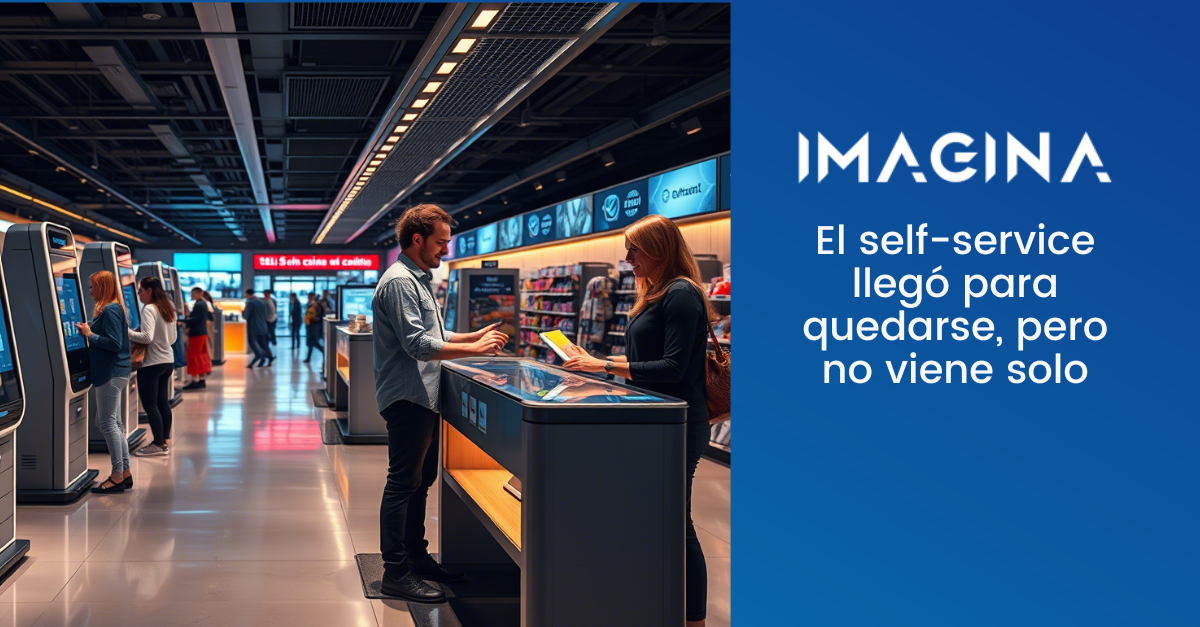
Self-checkouts, kiosks, lockers, infinite hallways, virtual assistants... All this sounds (and is) efficient. But the question that hangs in the air is: are we replacing people or simply transforming their functions? Are we designing stores without soul or intelligent spaces designed to sell better and serve better?
Let's see, this does not have a simple answer and it is probably a quite subjective issue, which is why we have decided today to review the current scenarios and trends to analyze the panorama from a holistic perspective. Let's get to it!
What is happening in the world of self-service?
Automation in retail is not a fad, it is a reality in full expansion. The global self-service solutions market, which already exceeded $32 billion in 2020, aims to reach $88 billion by 2030, according to recent data. Added to this is high public receptivity:
71% of consumers already use or are willing to use self-collection systems, and more than a third demand faster and more convenient options.
This is not just a trend; It is a structural change driven by the need to optimize operations, reduce costs and respond to the expectations of an increasingly impatient and self-sufficient consumer.
In this context, solutions such as smart lockers for collecting online orders, agile returns kiosks, digital assistants for in-store orientation and the famous “infinite aisle (which allows access to the entire online catalog from the physical store) are gaining traction. But behind each technological solution, there is a strategic decision: do I automate to be more efficient or to serve better?
What about jobs? Are they lost or changed?
This is where automation often generates resistance. The perception that machines replace people is not new, but does not always conform to reality. What we are seeing in many cases is a reconfiguration of work rather than an elimination.
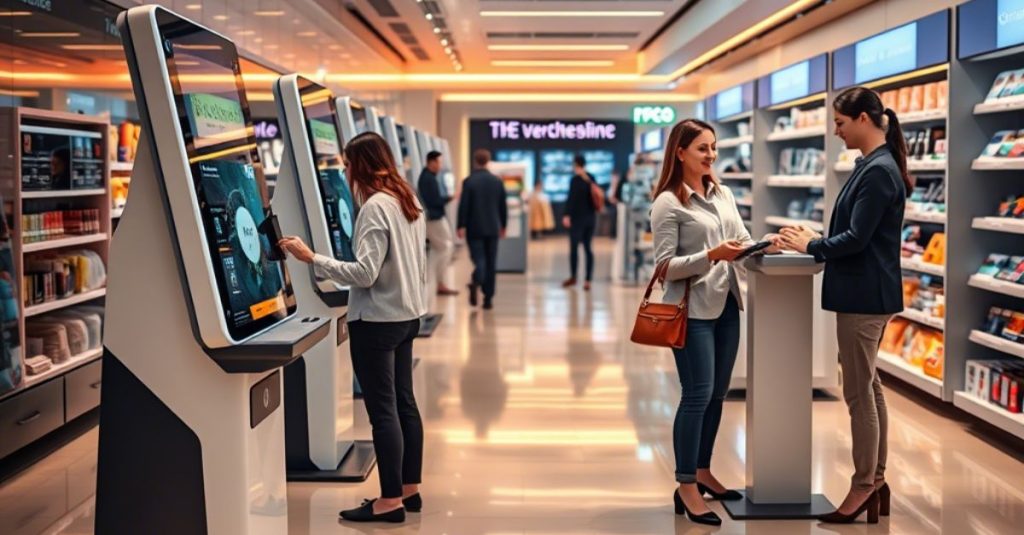
Employees who previously operated checkouts now help customers use self-checkout systems, replenish products, or play a key role in the experience: resolving questions, advising, managing complaints.
In the United States, for example, chains such as Walmart or Kroger have transformed traditional roles, positioning staff as facilitators of the self-service experience. This change responds to operational needs and also to the demand of a client who does not always want to interact, but does need a quick solution when something goes wrong.
It is important to understand that self-service does not mean self-sufficient. Technology needs human support, even if it is less visible.
The opportunities are real and measurable
When automation is implemented judiciously, its benefits are clear. In operational terms, collection errors decrease, the number of transactions per minute increases, and the use of space and personnel is optimized.
For the customer, the experience improves in speed, autonomy and control. But there is also a less tangible and very valuable effect: the perception of modernity. An environment where the customer feels they can decide how and when to interact generates loyalty, especially among younger generations.
Now, automation does not mean leaving everything to the machine. The key is that the experience is fluid and supervised, not unattended. A poorly designed self-service system or one without human support can generate more frustration than a long line. Therefore, the true differential lies in how the human and the technological are integrated.
Artificial intelligence enters the scene
In recent years, automation has been enhanced with artificial intelligence. We are no longer just talking about machines that scan products, but about systems that detect fraud in real time, dynamically adjust cash flow, recommend products and manage personalized promotions according to the customer profile. Solutions are even beginning to appear that recognize products without having to scan them, thanks to computer vision and contextual AI.
In the second part of this series, we talk about this and much more, don't miss it 👇
This does not mean that everything should be automated or that human intervention is dispensable.
On the contrary. These systems work best when people can intervene to interpret data, resolve exceptions, and provide judgment. Therefore, the future of smart retail is not 100% automated. It is hybrid, flexible and customer-focused.
The trends that are still valid and those that evolve
Much of what was proposed as a trend in 2023 has today been consolidated or adapted. Click & collect, for example, continues to grow, but now relies more and more on smart lockers and mobile notifications.
Return kiosks have become a key tool to build loyalty in fashion and electronics retail. Infinite aisle works well in certain segments, but its implementation requires robust integration with current inventory and logistics. And digital guidance is no longer just signage on screens, but virtual assistants capable of guiding and even selling.
The important thing is to understand that none of these solutions is completely autonomous. All require integration with central systems, trained personnel and an experience design that considers the customer in all its variants.
And how do we see it?
Yes, we are a technology company. But we are also realistic. Automating for the sake of automation doesn't make sense. We believe in efficiency, of course, but also in experience. And that experience often needs a face, a voice, a person. We are not in favor of retail without humans. We are in favor of frictionless retail.
For this reason, we are committed to intelligent solutions that combine technology with proximity. Let them automate processes where it makes sense and maintain human intervention where it adds value. Because in an increasingly digital world, the human touch is now the true differentiator.
What's next in the series?
In the next and final installment of “The Smart Box,” we are going to address a question that generates both debate and headlines: is the future cashless?
Spoiler: we don't believe it. And not only because our business is strongly linked to cash management, but because cash remains essential in many social, cultural and operational contexts. What we do believe is that it is changing, and its management must also evolve.
See you at the closing of the series: “Cash does not disappear: it transforms.
Do you want this vision delivered straight to your inbox? Write to us and we'll join you.