
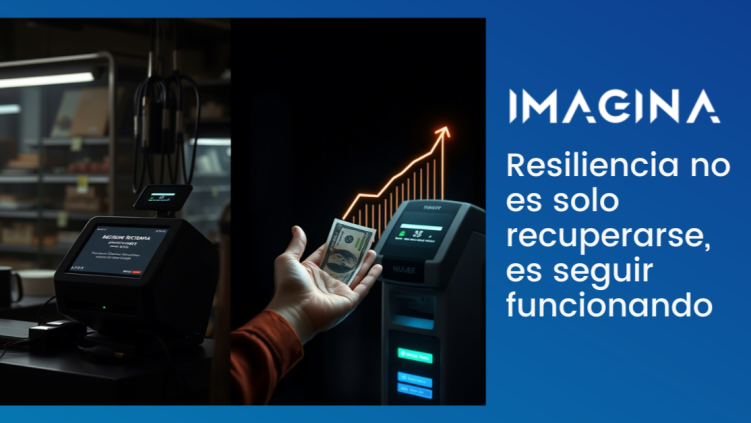
We are in the era where "Big Data" is king, real-time information seems to be the only currency of value. Businesses have become addicted to digital metrics.
We blindly trust in our shiny TPVs, in the apps that record everything, in the connectivity that, we assume, will always be there. We have convinced ourselves that each byte captured is one more step towards total efficiency.
But what happens to that operational intelligence when the primary source of data dries up? What happens to your business visibility when the network decides to take a vacation, the system freezes, or the power simply goes out ?
There is a constant flow of activity in many brick-and-mortar businesses. An exchange of tangible value that is often left out of this sophisticated digital matrix. A source of information to which, perhaps, we have not given the strategic value it deserves. And, above all, a data source that is not afraid of digital blackouts.
When the primary data source dries up: The fragility of single dependency
Our dependence on digital systems for every transaction and every sales metric is immense. A downed POS, an internet connection problem or an incident with the payment provider are not just annoyances. They are blind spots that can paralyze the operation and completely blind us to what is really happening at our point of sale.
We are not talking about a distant hypothesis. Failures in point-of-sale and payment processing systems cost businesses billions each year globally.
According to Forbes, citing data from the CEO of Omniwire, Inc., companies cost more than $400 billion in revenue every year. A retail business can directly lose thousands of dollars per hour in sales alone during a system failure.
Other sources, such as Atlassian (citing studies from Gartner and Ponemon), estimate that the cost of downtime can vary greatly, from hundreds to thousands of dollars per minute, depending on the size and sector of the business. And often, most of this cost is not the direct lost sale, but business interruption and reputational damage.
Pure digital dependence comes at a high price when technology inevitably fails.
The Tangible Activity Stream: A Potential Treasure Trove of Disconnected Data
But in the midst of this digital dependence, a type of interaction persists that does not need chips, fiber optics, or cloud servers to occur: the physical exchange of value. Yes, we are talking about that activity that some insist on withdrawing early: the cash.
Contrary to the narrative of its imminent demise, the use of cash remains a significant part of the economy.
According to the Study on Habits in the Use of Cash of the Bank of Spain of 2023, in Spain, the 65% of the population used it daily in 2023. And for the 60% of Spaniards continued to be their main means of payment in physical stores.

At the Eurozone level, the European Central Bank reported in 2024 that cash still represents 52% of transactions at points of sale (by volume), being the most frequent method, and the 39% for value. It remains dominant for small value payments.

Why is it still used? The reasons vary, depending on the BCE and the Bank of Spain: from budget management and preference for privacy, down to the simple habit, the ease of use or the perceived security.

It is an activity that occurs. It is a real value stream. But are we capturing the intelligence that general? Traditionally, this activity has been a “black hole” of data. Relegated to manual counts and spreadsheets at the end of the day. A potential treasure trove of disconnected data.
How technology digitizes the tangible: Your physical activity becomes resilient data
This is where smarter vision comes into play. It's not about going back to the notebook and the abacus. It is about using technology to transform that physical exchange activity (cash handling) into a structured and reliable digital data flow.
Think about every bill that comes in, every coin that goes out. If managed manually, it is an error-prone process – cash discrepancies are common (as noted by sources such as Nucoun), and the Association of Certified Fraud Examiners (ACFE) estimates that a significant portion of revenue is lost annually to internal fraud, something facilitated by manual handling (referenced by Xenia). Plus, it consumes valuable time.
But with intelligent cash management technology – the software (middleware) that connects your systems with the hardware, the recycling machines – each cash movement is recorded as ImaCash; ). It becomes usable digital data.
This “digitization of the tangible” is key. Your POS registers a card sale. Your cash management system records a cash receipt. These are two streams of income data that, when integrated with, give you a complete and accurate picture.
Information resilience: Why diversify your operational data sources
Having this flow of data on physical activity (intelligently managed cash) gives you a layer of informational resilience that purely digital businesses do not have.
When the network fails and your card transaction data stops flowing to your central system, the record of your cash receipts, captured and managed locally by your technology, is still there.
Essentially, you are building an operational “data backup” at the point of sale. A record of activity that does not depend on external connectivity at the time of the transaction.
This is not only important for the post-audit, but to have minimal visibility of the operation at critical times. Let's say it is a pill of your Business Continuity Plan (BCP) for payments, something essential to minimize losses and risks during interruptions, as experts in business continuity and payments point out.
The dark test: What the blackout taught us about the data that actually survives
We saw this manifest recently and on a large scale. The blackout that affected Spain, Portugal and other regions. Suddenly, the digital infrastructure collapsed for many. The TPVs stopped working, communications were cut. Companies whose operations depend 100% on these systems were paralyzed.
Anyway... what we already know. In the dark, not only physically, but also informationally.
However, businesses that maintained the ability to accept that “tangible activity” (cash) were able to continue operating. And those who had intelligent management technology were not only able to continue selling, but kept a record of that activity. They had a resilience operational data flow that others simply did not have.
It wasn't magic; was having the right data source running on "offline mode".
Implementing your forgotten data backup: Key steps
Once the “why” and “what” are understood – that there is a resilient flow of data in tangible activity and that technology can digitize it – the natural question is: how is this put into practice? Building this “forgotten data backup” is not an act of magic, but rather a structured process that modernizes a fundamental (and often outdated) part of your business operation.
Here are the key steps to implementing an intelligent cash management solution that provides you with this valuable operational intelligence and resilience:
1. Deep analysis of your current operation
- Before implementing, you need to understand your starting point. How do you manage cash today? What are the bottlenecks, the points of error, the fraud risks? What systems (POS, ERP, management software) do you already use?
- This step is important to define your real needs and how the new solution will integrate without unnecessary disruptions.
2. Design of the customized solution
- Based on the analysis, the appropriate technology is defined. This may include specific hardware (cash recycling machines, smart boxes, etc., choosing the models that best suit your volume and space).
- Fundamentally, the middleware software architecture is designed that will act as the brain, connecting this hardware with your existing business systems. It defines how the data will flow.
3. Smart integration: Connecting the dots
- This is the technical heart of the implementation. It's where middleware comes to life.
- The physical and logical connection is made between the cash hardware and your point of sale and back-office systems. The middleware is responsible for speaking the “language” of each device and system, ensuring that cash information (transactions, cash levels) is automatically captured and flows to where you need it.
- Experience in integrations is vital here to ensure smooth, two-way communication.
4. Software configuration and testing
- Once connected, the cash management software is configured according to your business rules: cash limits per cash register, user permissions, types of reports required (cash closings, cash counts, audits), alerts, etc.
- Extensive testing is performed to ensure that every transaction, every count, every report works perfectly and that data is recorded correctly across all connected systems.
5. Hardware deployment and team training
- Cash management hardware is installed at your locations.
- Simultaneously, your frontline staff and management team are trained in the use of the new machines and new software. A successful adoption depends on the team feeling comfortable and confident with the new process.
6. Commissioning and monitoring
- Once installation and training is complete, the device is “Go-Live.”
- Initial monitoring is essential to ensure that everything is working correctly, resolve any issues quickly, and verify that data is flowing as expected to your “forgotten backup” and operational intelligence systems.
Implementing your forgotten data backup is investing in the robustness and visibility of your business. It's a technological project, yes, but with a direct and tangible impact on your efficiency, security and, crucially, on your ability to continue operating and measuring even when the digital environment becomes uncertain.
A partner with experience in middleware and integration can greatly simplify this path. (Wink-wink 😉)
Towards truly resilient operational intelligence
The lesson is clear: in an environment of increasing digital dependencies, assuming that your main source of data will always be available is a risk.
True operational intelligence, the one that allows you to navigate turbulent waters, comes from the diversity and resilience of your information sources.
Managing cash intelligently is not a step backwards in digitalization. It is a step forward in strategic resilience. It is recognizing the value of that “tangible information” and equipping yourself with the technology necessary to capture and manage it securely and efficiently, even when the main digital infrastructure fails. It is building a professional “offline mode” for your business.
At Imagina ITS, we specialize in being that connector. That enabler that transforms cash management into a resilient and valuable data flow. Our middleware solutions such as ImaCash and ImaPlay optimize daily operations with cash, reduce errors and times and ensure that this critical activity generates reliable information that survives system crashes.
They are your guarantee that the "operational intelligence" does not turn off when the power (or the network) goes out.
Is your business prepared to maintain visibility and operation when digital infrastructure fails? Or does your operational intelligence shut down with the system?